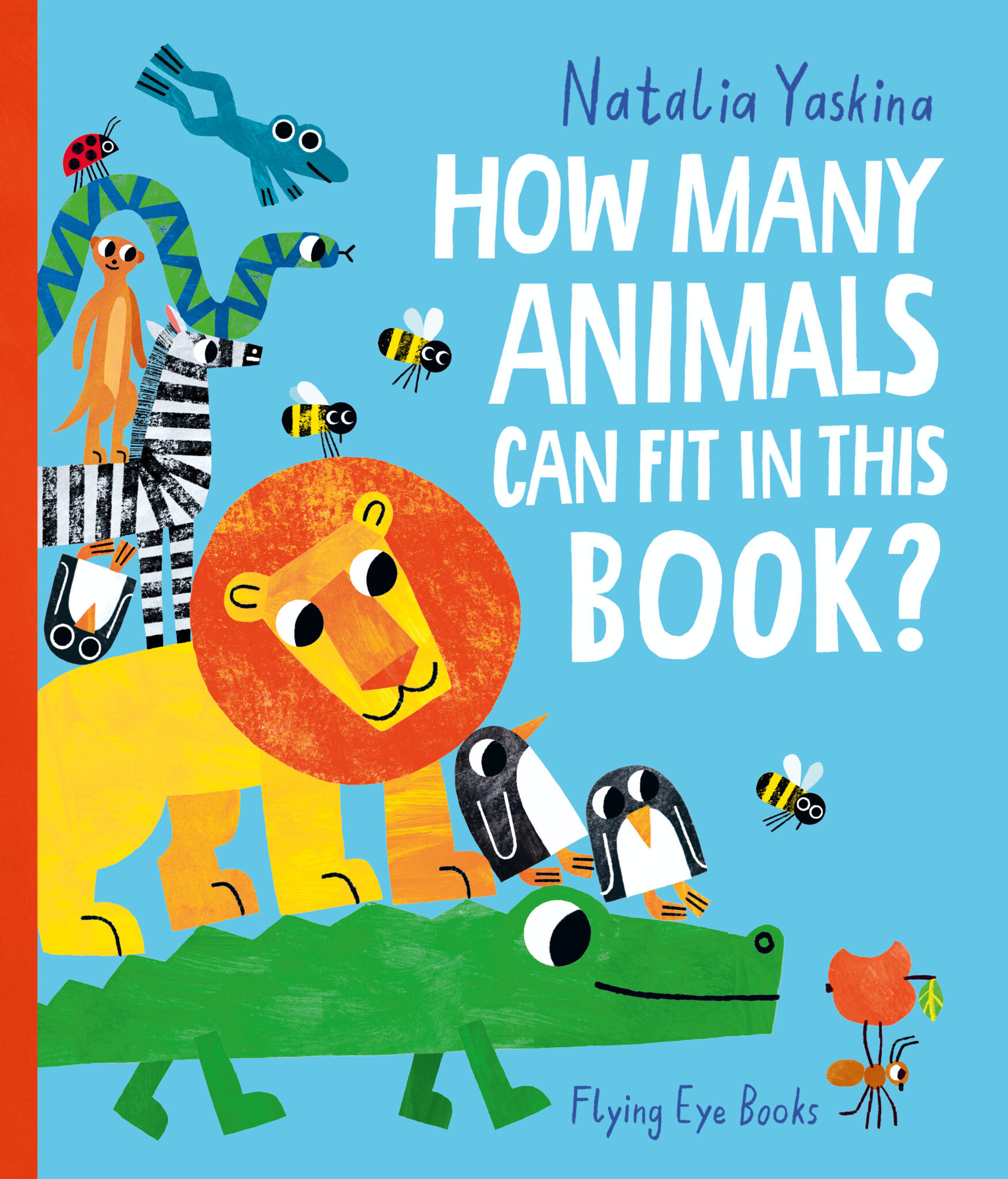
To celebrate the publication of How Many Animals Can Fit in This Book?, we sat down with author and illustrator Natalia Yaskina for a meet the creator QnA to learn all about this perfect, bright, and laugh-out-loud counting book!
How Many Animals Can Fit in This Book is a counting book, but unlike many other counting books for young readers, it has a very exciting and energetic story. What inspired you to make a counting book, and what techniques did you use to make it such an engaging read?
In the very beginning, my idea was to create a playful picture book with animals filling it like abstract objects filling a box. I wanted to create a space inside the book where it feels as if the characters truly lived on the pages. I started to brainstorm: what story could make all of this happen? I came up with the idea of a small animal in the center who doesn’t want to share and tries to keep the book for himself, not letting the bigger animals in. An ant worked perfectly for this role.
But it still wasn’t a straightforward counting book. Honestly, in the first sketches, it was a pretty complicated story: animals ate each other, gave birth to new animals, and everything was chaotic. So, I looked for ways to make it clear and simple, and I finally landed on the counting book format.
When I started to draw the animals in color, it didn’t work at first; they didn’t look right to me no matter how hard I tried. Then I realized I should try cutting them from colored paper instead of drawing them. The collage technique worked perfectly because it gave the exact feeling I needed: the animals started to look like they belonged in the book, as if it were truly their space to live in.
What influences your illustration style? Having grown up in Russia and moved to the USA, do you have any interesting references that might be new to UK readers?
Having an art education in Russia gave me a strong foundation and a deep respect for the traditions of illustration and classic book design. After university, I fell in love with picture books from the early-to-mid 20th century and classic Soviet artists like the avant-gardist Vladimir Lebedev and Yuri Vasnetsov, whose illustrations are deeply linked to Russian folk art.
On the other hand, I am very inspired by collage artists like the American illustrator Eric Carle and the Italian Leo Lionni. One of my favorite illustrators of all time is the Russian-American artist Vladimir Radunsky. His picture books feel like an artist’s playground to me; they are so energetic and fun, yet expressive and masterful at the same time.
You’re a very experienced illustrator, having made books for publishers around the world. Have you come across many differences illustrating for different audiences, or do you think pictures are a universal language?
Pictures are indeed a universal language, and I feel lucky to be an immigrant illustrator. If I were an author working only with text, it would be much harder. However, differences do exist. I would say that in Russian picture book culture, the text usually takes the lead, with illustrations serving as a kind of visual commentary (except for the avant-garde tradition of the early 20th century, where images were equal to or even more important than the text).
Graphic storytelling and image-driven picture books—my main interests right now—are relatively new and developing very fast in my native country. Earlier in Russia, I mostly worked as an illustrator for other authors’ texts, and my style back then was quite different from what I am doing now.
In my experience with other countries, European publishers often highly value beautifully crafted, handmade illustrations, while Chinese publishers often look for reliable, fact-accurate non-fiction picture books.
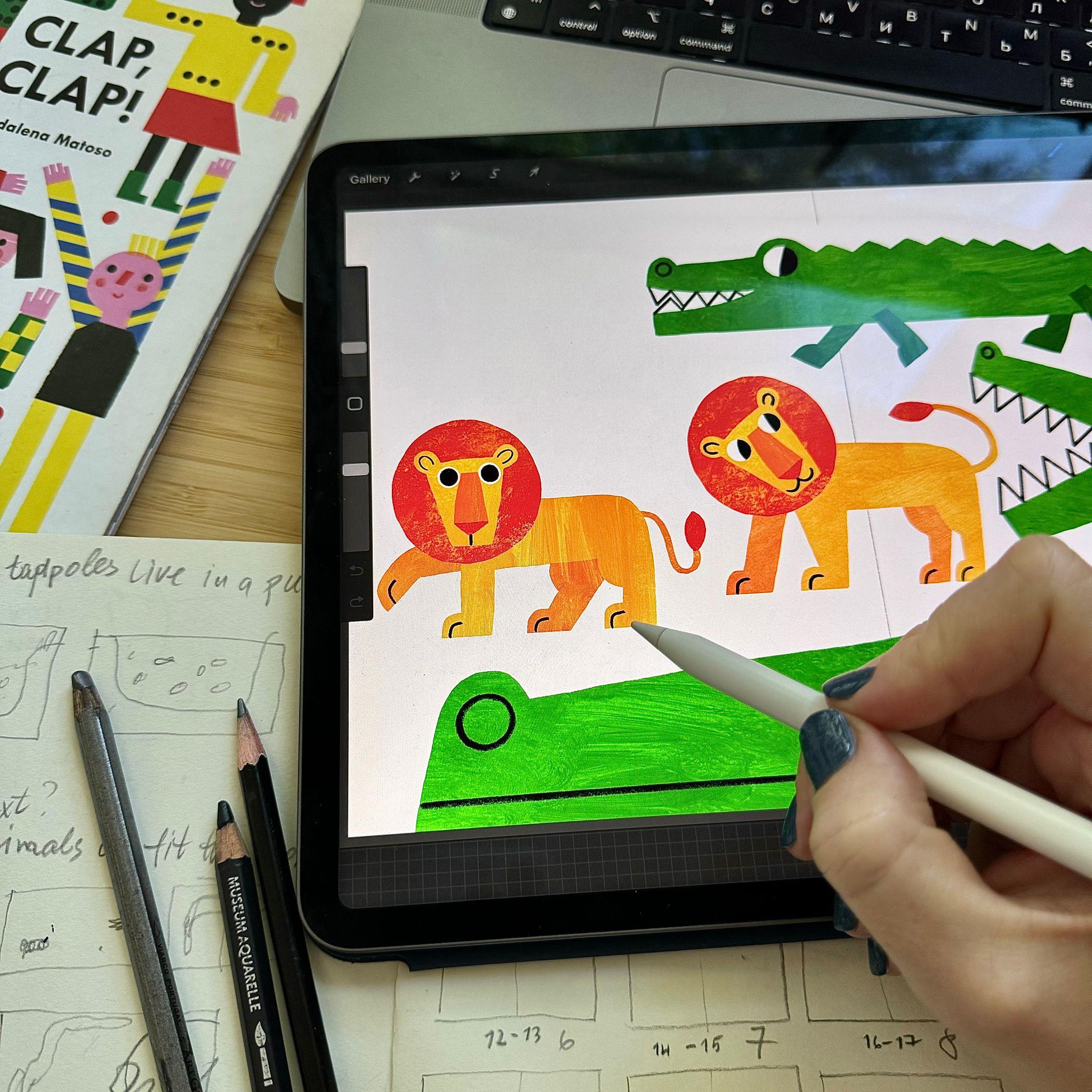
You’ve mentioned before that you feel that every picture book is unique and that you like to develop new approaches for each one. What processes did you use to create How Many Animals Can Fit in This Book and what makes it different from your previous books?
I used a digital collage technique for this book. I painted real paper with gouache, scanned it, and then used Procreate to cut out forms and assemble my characters. My previous books were created with traditional media, like gouache on paper or mixed media that combined real drawing with collage.
I chose digital collage this time because I was looking for a more constructed, conceptual feeling. I think for small children, it’s much easier to learn to count using simple objects like squares or circles. So, on one hand, I wanted my characters to look like these simple geometric forms. On the other hand, I wanted them to have strong personalities and feel alive so a child could empathize with them. Collage felt like the perfect way to hit both of those goals.
Ant gets very frustrated at being crowded out in the book, do you ever feel the same? Or do you think “the more the merrier” like the other animals?
Ha ha! Well, my husband and I have three kids, so I definitely feel like the ant in my book sometimes. However, I can’t imagine myself without my big family, so yes, ‘the more the merrier’ also applies to me. That way, I can empathize equally with all the characters in the book.
What’s your favourite animal?
I think my favorite animal right now is the tiger, because my next picture book is about him.
How Many Animals Can Fit in This Book?
by Natalia Yaskina
Just how many animals can fit in this book? Ant will tell you loud and clear: the answer is ONE. But will Ant mind if other animals join the pages, too? Two lions? Four zebras? How about eight penguins?
A humorous picture book that cleverly shows that there is enough room for everyone – while acknowledging that, sometimes, we may need our own space.
Get your copy HERE